



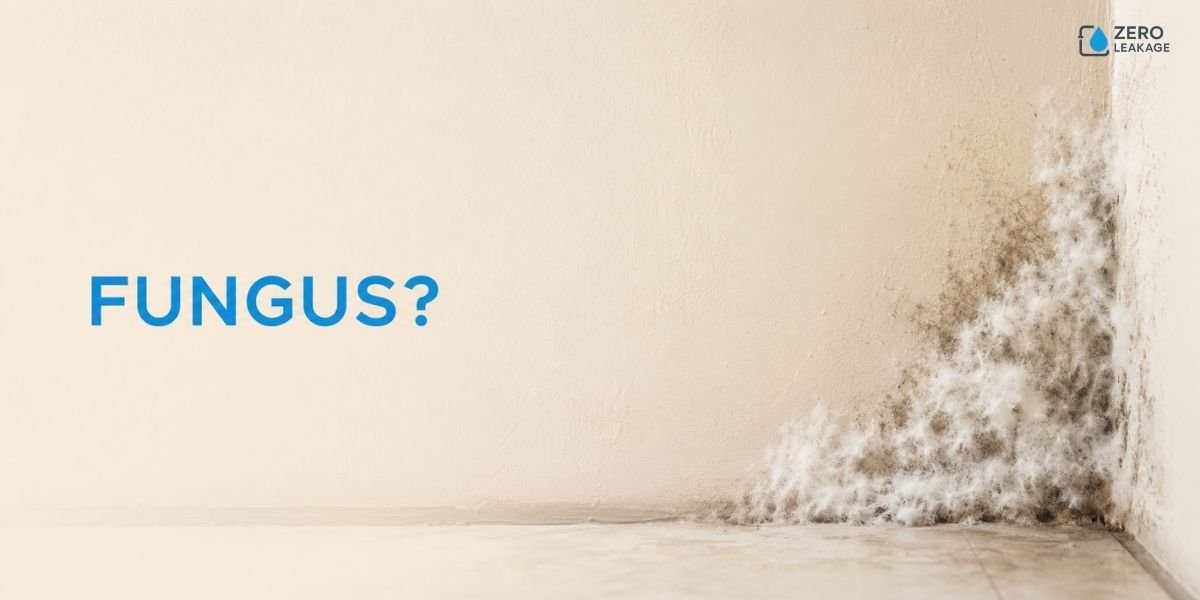
That fuzzy white patch in the corner of your bedroom isn’t just ugly – it’s a warning sign your walls are sending you. Ignore it, and you’re looking at crumbling paint, structural damage, and air you probably shouldn’t be breathing.
What Is Fungus on Walls?
Fungus on walls – also called mould or mildew – is a living organism that thrives wherever moisture meets a porous surface. It feeds on organic matter in your paint, plaster, and wall substrate, breaking them down silently over time.
It can look like:
- Black fungus on walls – dark, spreading patches, often in corners or behind furniture
- White fungus on walls – powdery or cotton-like growth, sometimes mistaken for efflorescence (salt deposits)
- Green or grey patches – early-stage mould, common after rains
White cotton-like fungus on walls is particularly deceptive – it looks harmless but is often an active, airborne spore colony that can spread rapidly if the moisture source isn’t eliminated.
Dealing with wall fungus issues? Learn how to remove fungus from walls and prevent future damage.
What Causes Fungus on Walls?
Fungus doesn’t appear randomly. Every outbreak has a moisture source behind it – and that source is almost always hidden.
1. Water Leakage and Seepage
The single biggest culprit. A pipe leak inside a wall, a terrace waterproofing failure, or a plumbing joint dripping slowly for months creates the perfect wet environment for fungal colonies to establish themselves. By the time you see the fungus on your wall, the water damage has typically been building for weeks – sometimes months.
2. Condensation and Vapour
In rooms with poor ventilation, warm moist air hits cold wall surfaces and condenses into water droplets – particularly in bedrooms, kitchens, and bathrooms. This is a leading reason why fungus grows on walls in bedrooms even when there’s no apparent leak. The water source isn’t a pipe – it’s physics, and it’s happening invisibly every single day.
3. Fungus on Walls Due to Rain
Mumbai and Pune’s monsoon season drives moisture deep into exterior walls through cracks, poorly sealed window frames, and inadequate waterproofing. Fungus on walls due to rain typically appears 2–4 weeks after the monsoon begins, on north-facing or east-facing walls first.
4. Rising Dampness
Groundwater wicking up through the foundation and base walls is common in older buildings and ground-floor flats. The moisture travels upward through the plaster, feeding fungal growth from the base up – slowly, silently, invisibly.
5. Poor Ventilation
Stagnant air keeps humidity levels high. Closed rooms with no cross-ventilation – especially bedrooms – trap moisture against surfaces and accelerate mould growth.
6. Low-Quality or Old Paint
Standard wall paint has no antifungal properties. Once it ages and loses its surface integrity, it becomes organic food for mould spores.
Want to remove unwanted mold growth? Discover effective ways to get rid of mold and protect your property.

How to Identify Fungus on Walls?
Not every wall discolouration is fungus. Here’s how to tell:
| Sign | Likely Cause |
| Fuzzy black or grey patches | Black mould (Cladosporium or Aspergillus) |
| White powdery crust | Could be efflorescence (salts) or early white fungus |
| White cottony growth | Active fungal colony – treat immediately |
| Musty or earthy smell | Hidden fungal growth, even if not visible |
| Paint bubbling or peeling | Moisture trapped underneath – fungus likely forming |
| Damp patch with no visible pipe | Internal water leakage – needs professional detection |
The cotton-like test: Rub the white substance. If it smears and has a faint musty smell, it’s fungus. If it’s gritty and chalky, it’s more likely efflorescence – but either way, both signal a moisture problem that needs attention.
Need professional help for your leakage problems? Contact us today for expert water leakage detection services.

Is White Fungus on Walls Dangerous?
Yes – and more so than most people realise.
White fungus on walls and black mould both release microscopic spores into the air you breathe daily. Prolonged exposure is linked to:
- Chronic respiratory issues (wheezing, persistent cough)
- Worsening of asthma and allergies
- Sinus infections and nasal congestion
- Eye and skin irritation
- In severe cases – hypersensitivity pneumonitis
Children, elderly residents, and anyone with respiratory conditions are at significantly higher risk. If you’re seeing recurring fungus in a bedroom where someone sleeps every night, this is not a cosmetic problem. It is a health hazard being fed by a water source you haven’t found yet.
Areas Most Prone to Wall Fungus Growth
- Bathrooms and kitchens – high humidity, steam, and water splash
- Bedrooms – condensation from breathing, poor airflow, AC units
- Corners and behind furniture – low airflow traps moisture
- Basement and ground floor walls – rising damp
- Walls adjacent to bathrooms – hidden pipe leaks that nobody has detected
- Exterior-facing walls – rain-driven seepage, especially post-monsoon
Not sure what type of wall crack you have? Explore the 10 common types of cracks in walls and their solutions.
Common Mistakes That Make Fungus on Walls Worse
This is where most homeowners lose both time and money.
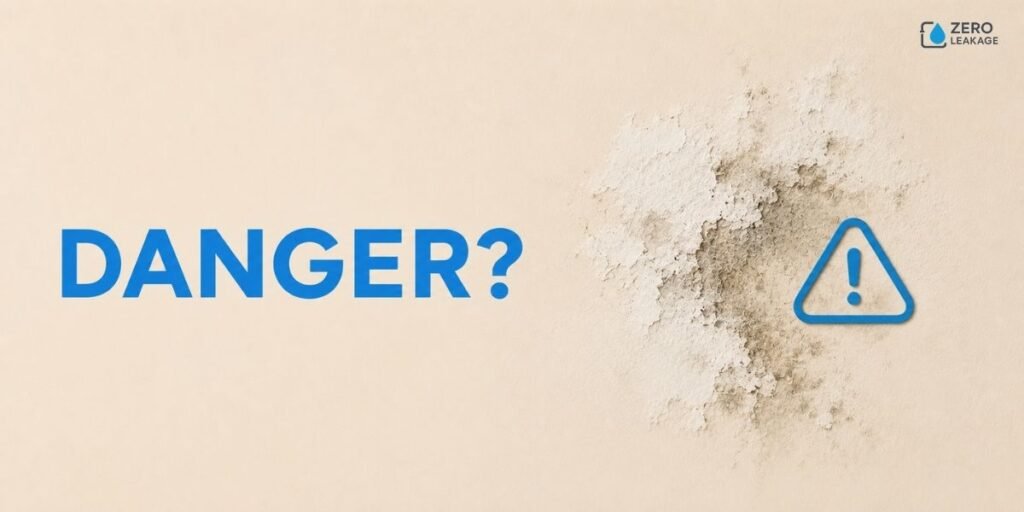
- Painting over it – covering fungus with a new coat of paint without treating the surface just seals moisture in and the fungus comes back within weeks, often worse. This is the most common and most expensive mistake.
- Using bleach directly – bleach kills surface spores but doesn’t penetrate into plaster; the root structure survives and regrows within weeks.
- Ignoring the moisture source – treating fungus without fixing the underlying leak or seepage is the definition of a temporary fix. You are spending money to delay the problem, not solve it.
- DIY scraping without protection – scraping active mould without a mask releases thousands of spores into the air, spreading the colony to other walls.
- Over-ventilating too quickly – opening windows during peak monsoon humidity can introduce more moisture than it removes.
- Trusting surface appearance alone – the visible fungus patch is rarely where the moisture problem is. The source is almost always inside the wall, above the ceiling, or in a concealed pipe – somewhere the eye cannot reach.
Searching for an accurate way to find hidden leaks? Learn more about our advanced water leakage detector solutions.

How to Get Rid of Fungus on Walls: Step-by-Step Treatment
Step 1 – Try the Home Remedies First (For Mild, Isolated Patches)
If the patch is small, hasn’t recurred before, and there’s no structural moisture source behind it, home treatment can work as a first step:
- White vinegar spray – apply undiluted, leave for 1 hour, scrub with a stiff brush and wipe clean. Vinegar’s acidity kills surface mould effectively.
- Baking soda paste – mix with water into a paste, apply, let dry, scrub off. Mild abrasive + natural antifungal.
- Hydrogen peroxide (3%) – spray on, leave 10 minutes, wipe clean. Works well on porous surfaces.
- Improve ventilation in the room – exhaust fans, open windows during dry hours, reduce indoor humidity sources.
These methods work. But they come with an important caveat: they only address what’s on the surface. If the fungus returns within a few weeks of cleaning – or if it’s in a spot with no obvious ventilation issue – the problem is not on the wall. It’s inside the wall.
Step 2 – Apply Antifungal Primer and Paint (Surface Treatment)
Once the surface is clean and fully dry (minimum 24–48 hours):
- Apply an antifungal wall primer formulated for Indian climate conditions – this creates a chemical barrier that standard primer doesn’t offer.
- For bathrooms and kitchens, use epoxy-based or moisture-resistant primers.
- Repaint with antifungal paint – premium formulations include built-in fungicide that provides additional protection.
Antifungal paints offer real protection for 3–5 years under normal conditions. They are a worthwhile upgrade over standard paint – but they are a surface solution. They cannot stop moisture that is actively seeping through the wall from inside. Think of antifungal paint like a good raincoat – it helps when there’s a light drizzle, but if there’s a river flowing through your wall, no coat will save you.
Step 3 – Waterproofing Treatments (For Seepage and Rain-Driven Fungus)
For exterior walls, terraces, and areas where rain-driven seepage is the cause:
- Apply crystalline waterproofing compounds on the external face of the wall – these penetrate the concrete and seal micro-cracks from within.
- Re-seal window frames and expansion joints with weather-grade sealant before every monsoon.
- Apply elastomeric waterproof coatings on terraces and external walls – these flex with the structure and don’t crack with seasonal movement.
- Fix grout and tile gaps in bathrooms – a 1mm gap in bathroom tiling can allow significant moisture to reach the wall behind it over time.
These treatments are effective and necessary – but they solve identified, visible entry points. What they cannot solve is a moisture source that nobody has located yet.
Step 4 – The Step That Actually Makes Everything Above Work Permanently
Here’s the truth that the vinegar, the antifungal paint, and the waterproofing coatings all quietly depend on: you have to find the water source first.
Every treatment from Step 1 to Step 3 is building on sand if the moisture feeding the fungus hasn’t been precisely located and sealed. This is the step most people skip – not because they don’t want to do it, but because they don’t know how.
Hidden water sources – a pipe joint dripping 2mm of water per hour inside a wall cavity, condensation forming on a thermal bridge in a bedroom ceiling, seepage entering through a hairline crack in an external façade – are completely invisible to the naked eye. You can scrub, prime, and repaint all you want; the moisture keeps feeding the fungal root system through the plaster, and within a season, it’s back.
This is precisely what advanced leak detection technology was built to solve.
Thermographic (infrared) inspection reads temperature differentials across wall surfaces. Moisture-affected areas hold temperature differently than dry areas – a thermal camera makes this visible as a heat map, revealing exactly where water is present inside a wall, behind a ceiling, or beneath a floor, without a single wall being broken.
Ultrasonic leak detection goes further – it can detect the acoustic signature of water moving through a hidden pipe, pinpointing the source to within centimetres.
Together, these two technologies do what no home remedy and no paint can ever do: they tell you exactly where the water is coming from, so you can seal it at the source – once, properly, and for good.
This is the difference between treating fungus and solving it.
Want to know more about our expertise? Learn more about Zero Leakage and our approach to solving leakage problems.

How to Prevent Fungus on Walls Permanently
- Find and seal every hidden moisture source – do not wait for fungus to appear; by the time it’s visible, the water has been there for weeks
- Pre-monsoon inspection – get walls, terraces, and plumbing checked before June every year in Mumbai and Pune
- Improve ventilation – exhaust fans in bathrooms and kitchens, avoid trapping humid air in closed rooms
- Use antifungal primer and paint in high-humidity rooms as your baseline
- Don’t dry clothes indoors without ventilation – a single load of wet laundry raises indoor humidity significantly
- Monitor ground-floor and basement walls after heavy rains – rising damp can begin before it’s visible
- Act on early signs – paint bubbling, a musty smell, or a small damp patch are all early warnings; address them before the colony establishes

Fungus on Walls Treatment by Room Type
| Room | Primary Cause | Treatment Focus |
| Bedroom | Condensation, poor ventilation | Detect condensation source, improve airflow, antifungal paint |
| Bathroom | Steam, splash, hidden pipe leaks | Waterproof grout and tiles, check concealed plumbing |
| Kitchen | Steam, wall-adjacent pipes | Ventilation, leak detection on adjacent wet walls |
| Living room (corner) | External seepage or terrace leak | Locate source via thermal scan, then waterproof |
| Ground floor | Rising damp | Damp-proof course + surface treatment after moisture mapping |

Myths and Misconceptions About Wall Fungus
Myth: “New buildings don’t get wall fungus.” False. Construction-stage moisture trapped in walls, inadequate waterproofing on terraces, and poor plumbing quality mean new buildings are often affected within 1–2 monsoon seasons.
Myth: “Antifungal paint alone will fix it.” Paint treats the surface symptom, not the moisture cause. Without locating and sealing the source, fungus returns – typically within 3–6 months. The paint never had a chance.
Myth: “If I can’t see a leak, there is no leak.” This is the most dangerous myth of all. The majority of recurring wall fungus cases are fed by hidden leaks – inside walls, above ceilings, or in pipe joints – that are completely invisible to the eye and only detectable with thermal or ultrasonic equipment.
Myth: “White fungus is safer than black fungus.” Both are harmful. White cotton-like fungus on walls can be just as allergenic and structurally damaging as black mould. Colour is not a reliable indicator of danger level.
Myth: “I can keep cleaning it every few months.” You can. But every time the fungus regrows, it penetrates slightly deeper into the plaster and wall substrate. What starts as a surface problem becomes a structural one over 2–3 years of repeated cycles.

Why Everything Else Is Temporary Without This One Step?
Walk through the logic of any fungus problem and you arrive at the same place every time.
Vinegar and home remedies – genuinely effective on surface growth, completely ineffective on a hidden moisture source. The fungus comes back.
Antifungal paint – real protection, real value, but only on a dry wall with no active water source. The fungus comes back.
Waterproofing coatings – essential for external walls and terraces, excellent for sealing visible entry points. Cannot seal what hasn’t been found. The fungus comes back.
Every solution in the treatment toolkit has the same dependency: you have to know where the water is coming from. Without that answer, every rupee spent on primers, paints, and coatings is a maintenance cost – something you’ll repeat every monsoon indefinitely.
The moment the moisture source is precisely identified and sealed – whether it’s a pipe joint inside a bathroom wall, a condensation hotspot on a thermal bridge, seepage through a terrace slab, or a hairline crack in an external façade – every other treatment step becomes permanent.
That’s not a small distinction. That’s the entire difference between a ₹500 recurring problem and a problem that’s actually solved.

Fungus appearing on your walls in Mumbai or Pune – and you’re not sure where the water is coming from? Zero Leakage uses thermographic infrared scanning and ultrasonic leak detection to locate hidden moisture sources with precision, without breaking walls. Once the source is found and sealed, your surface treatments hold – permanently.
📧 info@zeroleakage.in | 📞 +91 89766 13221 | 🌐 zeroleakage.in
FAQ: Fungus on Walls
How do you get rid of fungus on walls permanently?
Find the moisture source first – then treat the surface. In that order, always.
Is fungus on walls harmful?
Yes – every day it’s on your wall, it’s releasing spores into the air you breathe.
Why do I get fungus on walls during the rainy season?
Because monsoon moisture finds every crack your waterproofing missed.
What is the difference between wall fungus and efflorescence?
Efflorescence is salt – harmless and crusty. Fungus is alive, spreading, and a health risk.
Why does fungus keep coming back on walls despite painting?
Because paint covers the symptom – not the water source feeding it.
Can I use antifungal chemicals on walls myself?
For a first-time, small patch – yes. For anything recurring, the source needs to be found first.
Why does fungus grow specifically in my bedroom?
Warm breath + cold walls + closed doors = condensation. Your bedroom is quietly making its own water.
How do I know if my wall fungus is from a hidden leak or just humidity?
If it keeps coming back in the same spot – it’s a leak. Humidity spreads; leaks repeat.
Is white fungus on walls less dangerous than black fungus?
No – colour doesn’t determine danger. Both spread spores. Both need to go.
How long does it take for fungus to damage a wall structurally?
Faster than you think – unchecked mould weakens plaster and paint bonds within one monsoon season.


